Portfolio Construction · Volatility · Risk Management
By Joe Tigay, VIX market maker turned portfolio manager · For portfolio managers allocating capital on behalf of families
Thanks for reading Joe's Substack! Subscribe for free to receive new posts and support my work.
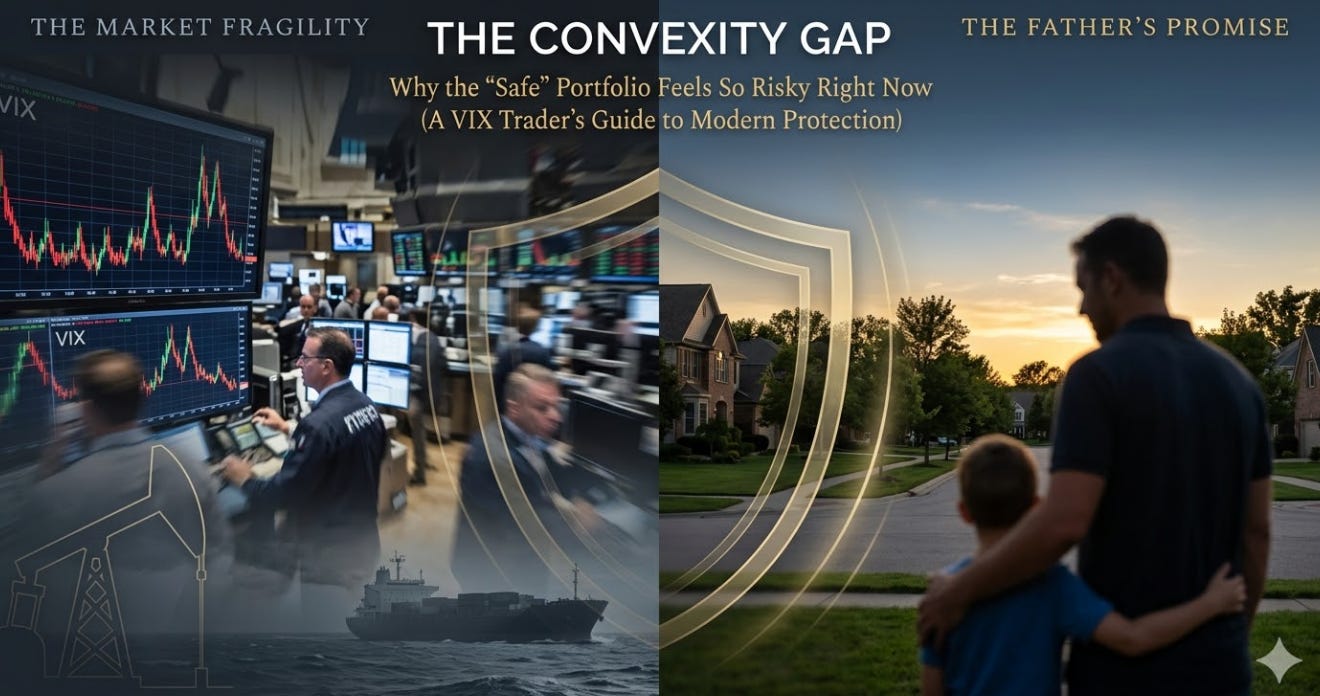
If you’ve been feeling a quiet unease while reviewing client allocations lately, you’re not alone. We were all taught that diversification is the “only free lunch” in investing. But right now, it feels like the portions are shrinking and the bill keeps arriving anyway.
Two active wars are reshaping global trade flows. Energy prices are whipsawing on every headline out of the Middle East. And the old static models of portfolio management — the ones we learned in the CFA curriculum, the ones clients expect us to use — are being pushed toward their structural limits.
This is not a panic note. It is an invitation to think more carefully about what “protection” actually means in the current environment.
· · ·
Concept 1
The correlation trap
As Portfolio Managers, our primary defensive tool has always been negative correlation: when equities fall, fixed income should rise. That relationship forms the backbone of the 60/40 framework and nearly every variation of it.
But in a high-inflation, high-uncertainty environment, that relationship can decouple — and it can do so at exactly the wrong moment. When energy prices spike and trigger sustained inflation fears, both stocks and bonds can sell off simultaneously. We saw a version of this in 2022. The conditions for a repeat remain present.
The lesson
You can’t just diversify by what you own. You have to diversify by how your protection behaves under stress.
Concept 2
Linear vs. convex protection — the difference that matters
Most portfolios are protected linearly. If you hold 40% in “safe” assets, you’ve dampened the blow. You’ve slowed the car down — but you’re still heading toward the wall.
Convexity is structurally different. Think of it as the airbag rather than the brakes. It sits inert during ordinary market conditions. It doesn’t drag on returns. It doesn’t create behavioral friction for clients who are watching good years tick by. But the moment there is a high-impact, rapid dislocation — a gap — it expands aggressively in the direction you need.
Long volatility strategies, implemented through options, can achieve this profile. When markets fall slowly, implied volatility (VIX) often doesn’t move much. But when markets gap down — when the kind of sudden, disorderly move occurs that triggers your clients’ behavioral breaking points — volatility can spike dramatically, and a properly constructed long-vol position can gain value from the very chaos that is destroying everything else in the portfolio.
This is not “betting against the world.” It is a structural offset designed to fire at exactly the moment a family’s financial plan is most at risk.
The practical question
Does your current allocation have enough convexity to survive a major energy shock — the kind that triggers simultaneous equity and bond drawdowns? Most don’t. Most were never designed to.
Concept 3
The human cost of volatility — and why stewardship matters more than math
I need to be honest with you about where my head is as I write this.
I live in Bloomfield Hills, Michigan, two miles from Temple Israel. Last week, a terrorist attack shook our community in a way that I am still processing. These are not strangers. These are the families of my close friends. These are people I see at Shabbat, whose kids play with my kids, whose faces I know.
I’m a Jewish father of three young children. And last week, dropping them off felt different. Looking at them felt different. The world felt more fragile in a way that no spreadsheet can capture.
When I sat down to think about markets this week, I kept coming back to the same thing: the work we do is not separate from moments like this. It is for moments like this.
The families in my community who were at Temple Israel last week — they aren’t thinking about their Sharpe ratio right now. They’re thinking about whether their lives, and the lives of the people they love, are going to be okay. That is exactly the emotional state our clients are in when markets dislocate. Fear doesn’t stay in its lane. It bleeds into everything.
Our job — your job, my job — is to be the person who already thought about this. Who already built the plan. Who can sit across from a client in the middle of their fear and say with genuine conviction: I prepared for this. You don’t have to panic. Here is what we have in place.
That is not a financial service. That is an act of care. And I don’t think we talk about it that way nearly enough.
I’ve always believed that people doing good for each other goes a long way. Right now, in my community and in this market, I believe it more than ever.
· · ·
My background
Why I think about this the way I do
I spent years as a VIX market maker on the floor of the CBOE. I watched firsthand how quickly “liquidity” can vanish. I saw how trades that appeared safe — hedged, diversified, institutionally blessed — could turn toxic in minutes when correlation assumptions broke down under real stress.
That experience is why I eventually became portfolio manager for the Rational Equity Armor Fund (HDCTX). I wanted to take the volatility mechanics I had seen work in the pit — the ones most retail and advisory channels never had access to — and build them into a structure that financial advisors could actually use for client portfolios.
But whether you use a fund or build your own internal hedging framework, the principle is the same: move from hope-based diversification to an armored one.
Three stress-test questions
Does your client’s portfolio have enough convexity?
Before your next client review, consider running through these questions:
If the S&P 500 fell 25% in a single month while the 10-year Treasury yield rose simultaneously, what would happen to this portfolio — and would the client stay invested?
What percentage of this portfolio’s “protection” relies on the stock/bond correlation holding? What is the plan if it doesn’t?
Is there any position in this portfolio that is explicitly designed to gain value when realized volatility spikes above 35?
If the answers are uncomfortable, that’s useful information. The goal isn’t to overhaul everything — it’s to identify the gap between the protection you think you have and the protection that would actually hold under a geopolitical shock scenario.
Want to go deeper?
If you’re curious about how long volatility mechanics work in practice — or want to explore whether a dedicated convexity allocation makes sense for your clients — I’m happy to talk through the specifics.
Learn more about the Rational Equity Armor Fund (HDCTX) →
This is a practitioner conversation between people who take financial responsibility seriously. Read more about my background and approach →
Thanks for reading Joe's Substack! Subscribe for free to receive new posts and support my work.