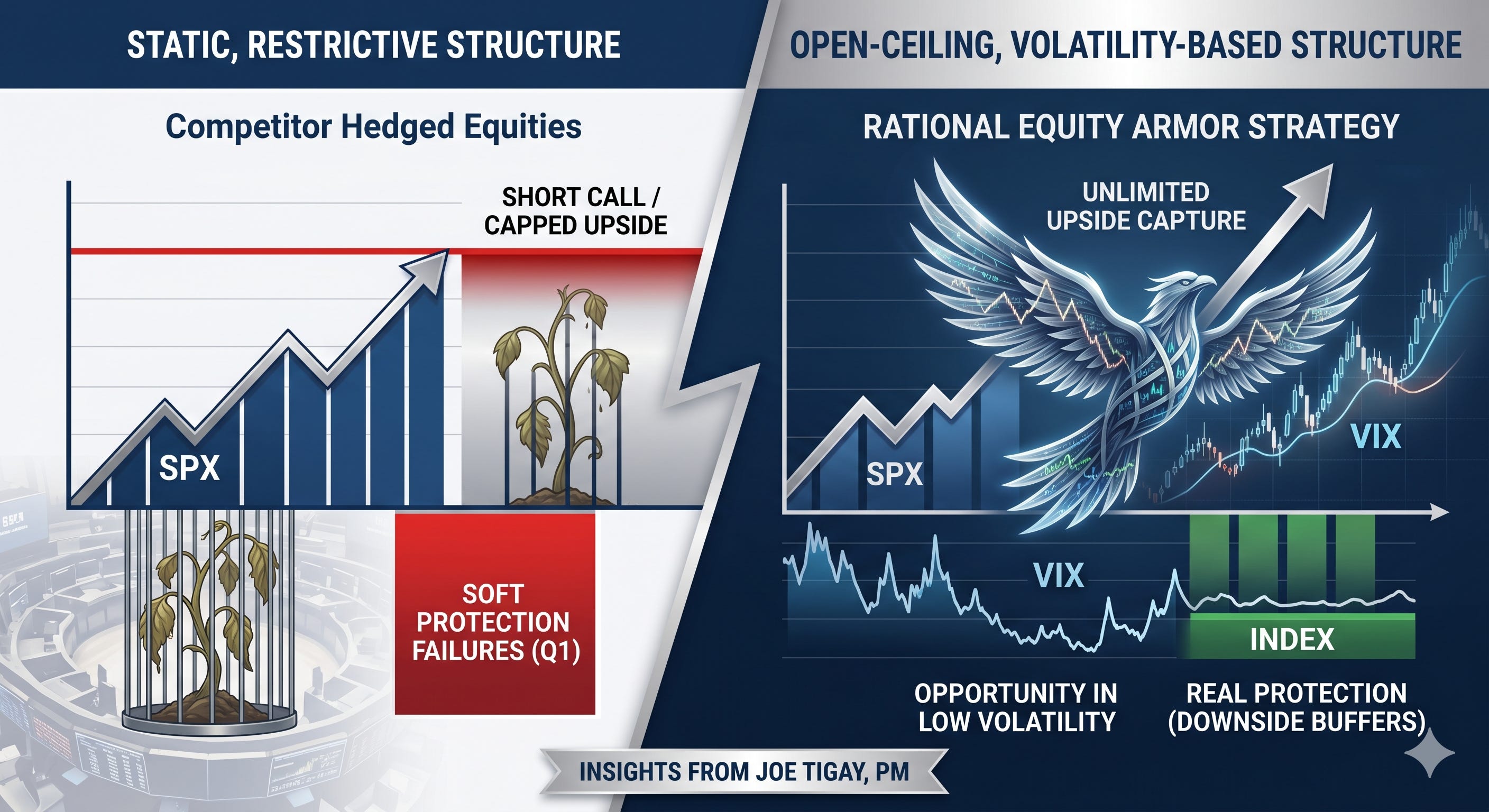
Looking back at the first quarter, there is a clear lesson in how different hedging strategies actually behave when the rubber hits the road. Many hedged equity strategies on the market today offer what I call “soft protection,” and in practice, that often means no protection at all when you actually need it.
The First Quarter Reality Check
The first quarter was exactly that kind of environment. Despite the marketing promises of a “buffer” or “downside protection,” many hedged equity funds finished the quarter down even more than the index itself. Investors were essentially paying a fee for protection that failed to show up when they needed it most.
Our strategy at Rational Equity Armor did much better. By avoiding the rigid structures that many of our competitors use, we were able to navigate the volatility of the first quarter without the same drag. This period proved that our approach can be significantly more effective when the market is under pressure.
April: Removing the Ceiling
While the first quarter proved we can be better on the downside, April proved we can excel on the upside. As the market found its footing and began to rip higher, our strategy was able to capture that move.
The reason is simple: our strategy rose without being held back by covered calls. Most hedged products “pay” for their protection by selling away the upside. When the market rallies, those investors are left behind, capped by a ceiling they sold to someone else. Because we don’t use that restrictive structure, we don’t have an upside call that stops us from gaining on market rips.
Opportunity in Low Volatility
We are currently seeing volatility come back down to very low levels. In my experience as a former pit market maker, I have learned that the best time to buy insurance is when it is cheap.
Volatility is the “insurance” for your portfolio. When the VIX is low, the cost of maintaining our volatility-based hedge is highly attractive. We aren’t just sitting in a static, restrictive collar; we are positioned to benefit if the market gets turbulent again, all while keeping the ceiling open for market gains.
If you are tired of strategies that fail to protect you on the way down and stop you from gaining on the way up, it is time to look at a strategy that understands the true mechanics of volatility.