The Squeeze in the Strait: Why Our ‘Armor’ is Generating Positive Carry in a Sea of Red
By: Joe Tigay, Portfolio Manager — Rational Equity Armor Fund
Good morning. Pour the coffee. This is the kind of morning I built this fund for.
If you woke up to red screens, a spiking VIX, and a Twitter feed full of geopolitical dread — welcome to the show. The headlines are doing what headlines do: selling fear. But here at the Rational Equity Armor Fund, fear isn’t a problem. Fear is the product.
Let me walk you through exactly what is happening, why it’s happening, and why — if you’re a long vol manager like me — this is our moment.
I. The “Two-Front” War: What Everyone Else Is Thinking
Most investors woke up today fighting on two fronts. The first is the geopolitical headline risk swirling around Iran — fast-attack boats in the Strait of Hormuz, saber-rattling over the US blockade, oil markets twitching. The second is the cold technical reality of the S&P 500: down roughly 3% since Friday, threatening meaningful support levels, and dragging the sentiment of every long-only equity manager with it.
Most people in this situation do what humans do. They panic. They sell. They “reduce risk.”
We are not doing that.
Here’s the thing I want you to internalize: we aren’t fighting the market today. We are letting the market’s panic finance our future gains. While the tape is ugly and the X and Reddit threads are catastrophizing, our VIX-Inversion Alpha has likely kept us in the game. We’re not just surviving the storm — the storm is making us stronger.
This is not luck. This is structure.
II. The Science Behind the “Negative Spread” — Why Backwardation is Beautiful
Let me get a little nerdy for a second, because this is the engine that is running right now.
We are seeing a -2.35 MAR/APR spread on the VIX curve. In plain English: near-term volatility is priced higher than forward volatility. The market is screaming that today is more dangerous than tomorrow.
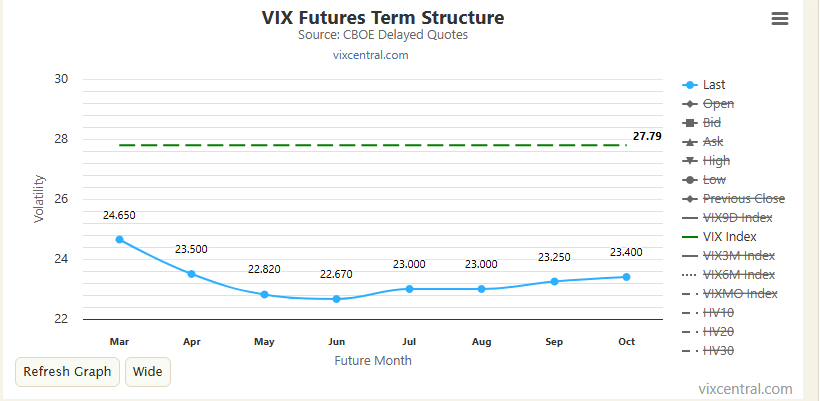
From VIXcentral.com
In normal, boring market conditions, we pay to hold VIX exposure — that’s the cost of contango, where futures in front months are cheaper than back months and you’re essentially leaking premium every day you hold. It’s the price of protection.
But today? The table has turned. In backwardation, the market pays us to hold it. Panicked hedgers — institutions scrambling to buy protection, retail investors flooding into puts — are effectively transferring a risk premium directly into our fund. We are the counterparty to their fear. We are being compensated to stay positioned.
This is the “Rational” in Rational Equity Armor. The architecture of this fund was designed precisely for this moment: the moments when everyone else is paying up for protection, and we’re already there, getting paid.
III. Geopolitics: The Hormuz “Swarm” and the Macro Fog
Iran’s deployment of fast-attack boat swarms is a direct tactical response to the US blockade posture. This isn’t background noise — it is a credible, real-world threat to one of the most strategically critical chokepoints on the planet. Roughly 20% of global crude flows through the Strait of Hormuz. The question isn’t whether a disruption matters. The question is: what does it actually do to the economy from here?
And that’s where it gets genuinely complicated — and why we don’t make big sector bets.
Cast your mind back to 2022. Russia invades Ukraine. Oil spikes. And yet — the US consumer absorbs it. Why? Because the government was in the middle of injecting roughly $2 trillion into the economy. Americans had the balance sheet to eat the price shock. Inflation ran hot, but the economy didn’t tip over. The fiscal cushion was enormous.
That cushion is gone.
Today, an oil shock lands in a very different environment. Private credit markets are already flashing concerning signals. Corporate balance sheets that looked fine at 4% rates are looking a lot less fine as refinancing walls approach. The consumer is stretched. And if oil spikes toward $120 on a Strait closure, the transmission mechanism isn’t inflation — it’s a brake. High energy prices slow consumption, compress margins, and can tip a fragile economy into contraction. Paradoxically, the most inflationary-looking headline event could end up being deeply deflationary in its economic effect.
But here’s the other side of that coin: does the government step in? Again? They have a habit of it. A bankruptcy wave in private credit, a seizing up of the leveraged loan market, a regional bank stress event — any of these could trigger another round of fiscal or monetary intervention that reflates the system and bails out the fragile parts, just as we’ve seen before.
Inflation or deflation. Shock absorption or shock transmission. Government backstop or hard landing.
We genuinely don’t know which path we’re on — and we’d be skeptical of anyone who tells you they do. What we do know is that this is exactly the environment where being long volatility structurally, without overcommitting to any single sector narrative, is the right posture. We don’t need to pick the outcome. We need to be positioned for the range of them.
That’s the armor.
IV. The “Long-Long” Win: What Comes Next
Here’s where the fun starts. Let me paint you two pictures.
Scenario A — Escalation: Kinetic conflict breaks out. The S&P drops to 6,400. VIX spikes to 45. Everyone is in margin call purgatory. Long-only managers are force-selling their best positions at the worst prices. And us? Our long vol position explodes. We have the liquidity, the dry powder, and the structural freedom to buy what I’m calling the “generational bottom” in Technology — while others are being liquidated. This is the scenario where being built differently pays off most visibly.
Scenario B — De-escalation: A “Vienna Surprise” — some form of diplomatic deal, a back-channel agreement, a joint statement that calms the room. VIX collapses back to 18. The S&P rips 5% in a session. Classic V-bottom. And guess what? Our equity beta captures that entire recovery. The Vol Armor has already done its job — it preserved our capital through the uncertainty — and now our equity exposure rides the relief rally up with everyone else.
We win in both scenarios. That is not an accident. That is the mandate.
Being a long vol manager in this environment isn’t a niche curiosity. It is an edge. And edges compound.
V. Today’s Trade: The Actionable Summary
Here is what we are doing — and not doing — today.
Today’s Mantra: Panic is a profit center.
We are not reducing equity exposure. Full stop.
We are monitoring the -3.00 spread level on the VIX curve as our key trigger. If the inversion hits -3.00, we begin “harvesting the vol” — systematically unwinding our volatility position into the spike to fund purchases of the S&P 500 dip. We are long growth, long chaos, and short fear.
Two specific levels to watch:
Spot VIX at 32: This is the statistical “exhaustion point” for most geopolitical panics. If we tag 32, history says the fear is likely at or near its maximum. That is not a sell signal. That is a buy signal for us.
10-Year Yield below 3.75%: If the 10-Year breaks through 3.75% to the downside, that is a “Flight to Quality” confirmation — institutional money moving into Treasuries, de-risking broadly. That signal tells us our Long-Long trade is perfectly positioned for the defensive pivot that follows.
The Bottom Line
There are very few funds in the world built to do what Rational Equity Armor does. Being long volatility structurally — not as a panic trade, not as a short-term hedge, but as a core alpha engine — is genuinely uncommon. Most of the industry is scrambling right now. Most of the industry is paying up for the protection that we already own.
This is our time.
The Strait of Hormuz is tense. The VIX is elevated. The headlines are screaming. And our armor is generating carry.
Stay long. Stay rational. Let the market’s fear fund your future.
More soon.
— Joe Tigay, Portfolio Manager Rational Equity Armor Fund
This content is for informational purposes only and does not constitute investment advice. Past performance is not indicative of future results. Please consult the fund’s prospectus and consider all risks before investing.