The Inflation Playbook Is Broken. And Nobody Wants to Say It.
By Joe Tigay, Former VIX Market Maker & Portfolio Manager
I’ve spent enough time on trading floors to know what panic smells like. And right now, the word “inflation” is having that effect on a lot of people. Oil is sitting above $110 a barrel. Prices are up. The word stagflation is making the rounds on financial television — which, as I’ve said before, is a great place to watch people say definitive things about things nobody actually knows.
So let me tell you what I do know. And more importantly, what makes this moment genuinely different from anything the textbook prepared us for.
The classic playbook has two chapters. And right now, we’re skipping both of them.
Inflation, historically, is a self-correcting problem. It slows spending. Slower spending cools the economy. The Fed raises rates. Credit tightens. Demand comes down. Prices follow. We’ve seen this movie.
The script requires two things to work: government restraint and Fed tightening. Pull both levers, the steam releases, you move on.
Here’s the problem. Both levers are stuck.
The federal government doesn’t just have zero appetite for cutting spending right now — if anything, we’re going the other direction fast. Defense spending already hit $1 trillion in FY2026. The proposed FY2027 budget pushes that to $1.5 trillion, and that number doesn’t even include what the war in Iran is actually going to cost. Some estimates say add another trillion on top. This isn’t a government tightening its belt. This is a government ordering dessert.
And the Fed? After their last meeting, the conversation inside the FOMC has shifted toward cutting, not hiking. The concern isn’t runaway inflation — it’s a softening labor market. In a classic inflationary environment, the Fed is supposed to be the one pumping the brakes. Right now they’re watching the speedometer and wondering if they should actually press the gas a little.
Both levers — the ones that are supposed to cool this thing down — are being pushed in the wrong direction.
But here’s what everyone is missing.
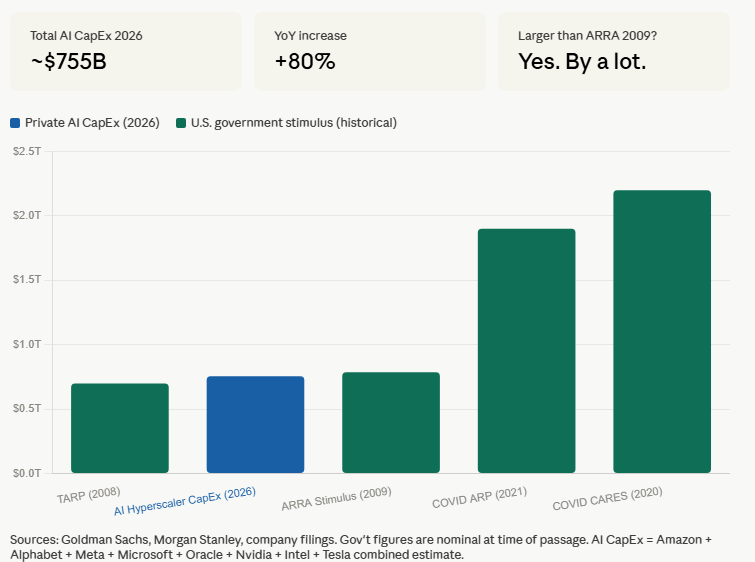
While people are debating oil prices and Fed minutes, there’s a $755 billion stimulus happening in plain sight that nobody is calling a stimulus.
Look at that chart above. The combined AI capital expenditure from America’s hyperscalers in 2026 alone — Amazon, Alphabet, Meta, Microsoft, Oracle, Nvidia, Intel, Tesla — comes out to roughly $755 billion. That’s not a prediction. That’s committed spend. That’s shovels in the ground, chips on order, data centers going up across the country.
The 2009 ARRA stimulus — the one we called “massive” for a decade — was $787 billion. We are essentially matching that, in a single year, through private capital deployment. And unlike government stimulus, this money is flowing into companies that are already seeing returns. This isn’t bridges to nowhere. Alphabet’s cloud revenue grew 63% in Q1 alone. This is productive capital.
I spent years on the floor watching how money moves through a system. When you inject this much capital this fast, it doesn’t sit still. It pays construction workers. It buys American-made steel and power infrastructure. It creates jobs in places like Ohio and Arizona and Oklahoma. A $1GW data center going up in Oklahoma is a real economic event — and there are dozens of projects like it happening simultaneously.
Is this inflationary? Sure, at the margin. Is it also a massive economic tailwind that cushions the blow? Absolutely.
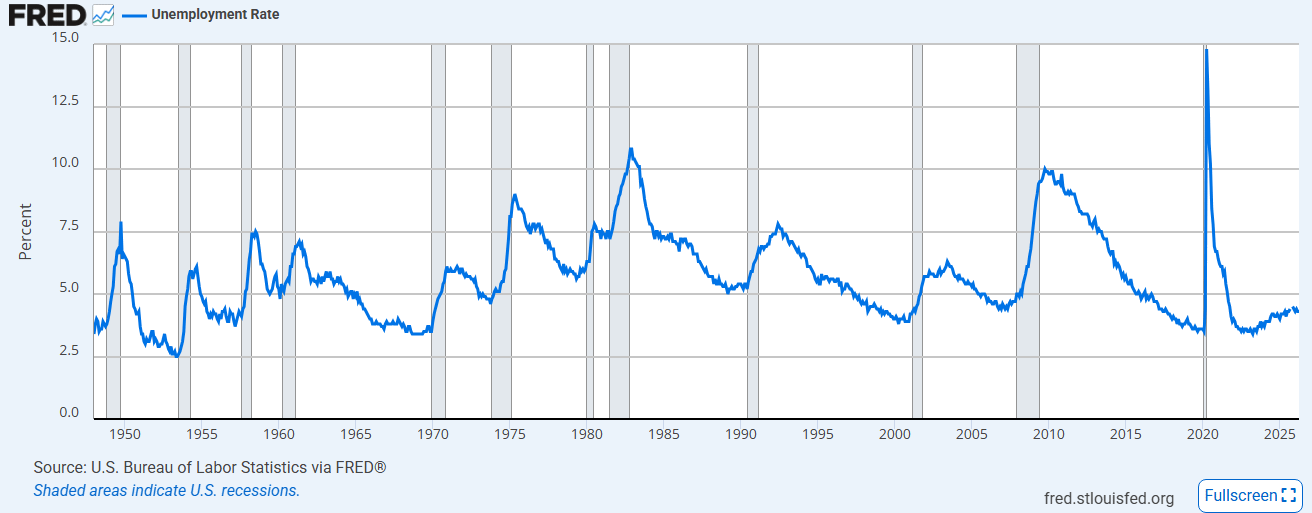
Unemployment is rising. But let’s keep some perspective.
Yes, unemployment has ticked up. I’m not ignoring that. But I’ve watched enough market cycles to know the difference between a data point and a trend — and right now we’re still operating well below any historical threshold that would suggest the economy is cracking. The labor market is not breaking. Between defense spending, AI infrastructure build-out, and energy investment, there are massive job-creating forces running in the background.
And then there’s the wildcard nobody wants to model.
A favorable resolution in Iran changes the oil picture dramatically and fast. Brent above $110 is real today. But the longer-dated futures markets — the ones with actual money behind them, not television pundits — haven’t moved nearly as much as spot prices. The market is quietly pricing in the possibility that this spike is temporary.
If Iran de-escalates, oil goes back below $70. Maybe below pre-war levels. And when that happens, the inflationary impulse that everyone is panicking about today evaporates almost overnight. Energy-driven inflation has an off switch that most other inflation doesn’t. That switch is geopolitical — and geopolitics can move fast.
Sound familiar? We called it “transitory” in 2021. We were wrong then — but the 2021 problem was supply chain chaos across every sector simultaneously. This is more concentrated. More reversible. The mechanism for it to end actually exists.
So what does this all mean?
I’m not here to tell you inflation is going to 3% by year-end. I don’t have a crystal ball — and anyone who tells you they do is, as I’ve said before, selling you something.
What I will tell you is this: the framework most people are using to think about this doesn’t fit the game being played right now. You’ve got massive government spending with no ceiling. A Fed leaning toward cuts. A $755 billion private stimulus that nobody is calling a stimulus. Employment that refuses to crack. And one enormous geopolitical wildcard that could flip the energy picture in a weekend.
The 1970s stagflation comparison that’s all over financial television? The economy is half as energy-intensive as it was then. Inflation expectations are still anchored. And we have a technology investment wave injecting productive capacity into the system at a scale the 1970s never saw.
This might get worse before it gets better. It also might resolve faster than anyone expects.
What I know with conviction is that the rules changed. And the people reading from the old rulebook are going to be the last ones to notice.
Joe Tigay is a former VIX market maker and Portfolio Manager at Equity Armor Investments. This is market commentary, not investment advice.