Let me be direct with you: most people are going to watch the Cerebras (CBRS) IPO this week and see a headline number. An unprofitable AI chip company, massive customer concentration, pricing at $160 a share on 20x oversubscription. They’ll see it as hype. Another hot deal in a hot market.
I think they’re missing the forest for the trees.
Thanks for reading Joe's Substack! Subscribe for free to receive new posts and support my work.
This IPO isn’t just about Cerebras. It’s a signal flare — and if you’re paying attention to what it means for IPO market structure, OpenAI’s balance sheet, and where we are in the broader AI infrastructure cycle, the picture gets a lot more interesting.
1. The Underreported Capex Monster
Reporters love talking about government stimulus. It’s an easy narrative: the Fed might lower rates, and Washington is still spending money like crazy. But they are completely missing the real story.
The size of this AI infrastructure buildout is absolutely massive, and it’s not coming from a Treasury printing press. Instead of buying back their stock to juice earnings, the largest companies in the world are taking their massive piles of cash and investing it directly back into themselves and into America.
We are seeing a private-sector capex cycle that dwarfs traditional government “stimulus” in its efficiency and long-term impact. This isn’t just “spending”—it’s a fundamental re-tooling of the economy. When the biggest players on the planet stop cannibalizing their own shares and start building massive physical and digital infrastructure, the effect on the economy is going to be tectonic. Cerebras is just one of the first visible beneficiaries of this shift.
2. OpenAI’s Balance Sheet: Paper to Power
This is the piece of the story getting the least attention. OpenAI holds 33.4 million warrants in Cerebras. At a $160 IPO price, that is an immediate $5.3 billion asset added to their books.
A multibillion-dollar liquid equity stake changes what OpenAI can negotiate on the lending side. And OpenAI needs that leverage right now. Their $500 billion “Stargate” buildout with Microsoft and Oracle doesn’t fund itself. More favorable lending terms on that project are worth real money — potentially more than the $5.3 billion headline number itself.
3. Are We in Stage 2? The ‘97/’98 Parallel
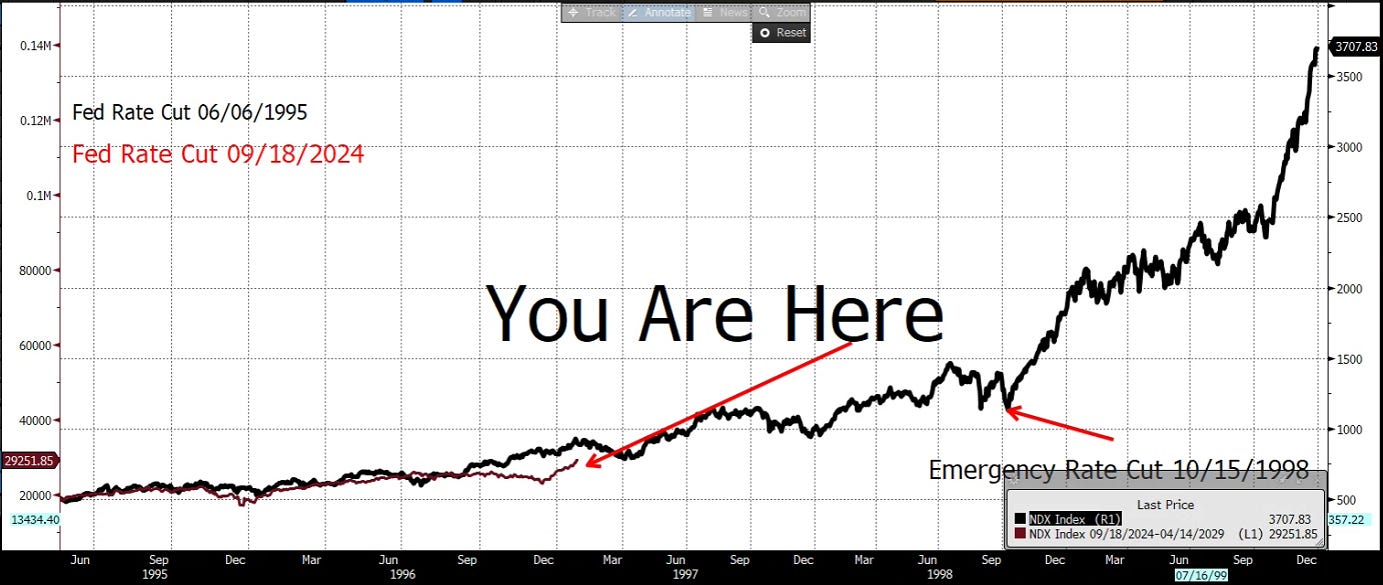
I’m careful about historical parallels, but look at the data. If you overlay the current cycle (starting from the first Fed cut in Sept 2024) against the 1995 cycle, we aren’t at the end. We are squarely in early 1997.
In 1997, the internet shifted from “interesting curiosity” to “infrastructure build-out.” That’s the moment everything accelerated. We are at that moment right now.
The Critical Difference — and How to Play It
In ‘98, most of the momentum names had “eyeballs” and no revenue. Pets.com had real products but zero economics. Cerebras is going public with $24.6 billion in performance obligations.
The floor on this cycle is higher because the underlying revenue architecture looks materially different from 1998. However, with this level of capex and massive valuation resets, we are entering a period of high-velocity moves.
That’s why I believe it makes sense to play this market long volatility. Most people think of “long vol” as a bet on a crash, but it can work just as well in up markets as it does in down markets. When you have this kind of massive infrastructure shift and concentrated gains, the “path” is rarely a straight line. Long volatility allows you to capture the expansion in range regardless of the direction.
What I’m Watching Friday
If the underwriters exercise their full over-allotment option—the greenshoe—on Friday, read that as a signal. It means the market is saying the Inference Trade is just getting started.
The Cerebras IPO is being called a Netscape Moment. I think that framing is slightly off. Netscape was the first signal. This is the second signal—the moment where the infrastructure buildout tips into the application era. That’s a sneaky big deal. Don’t let the headline number distract you from what it’s actually saying.
— JT
Thanks for reading Joe's Substack! Subscribe for free to receive new posts and support my work.