The Advisor's Dilemma: Keeping Clients Invested When the Safety Net Has Holes By Joe Tigay, Portfolio Manager — Rational Equity Armor Fund
Let me be direct with you, because I think most of what gets written for financial advisors talks around the real problem instead of at it.
The real problem is this: your job is to keep clients invested through the chaos, but the tools you’ve been handed to do that are broken.
The 60/40 portfolio was supposed to be elegant. Bonds as ballast, equities as the sail. And for decades, it worked. But in a world of sticky inflation and shifting correlations — where stocks and bonds fall together — that ballast is taking on water. When both sides of the portfolio are bleeding at the same time, your “Nervous Bull” client starts eyeing the exits. And no amount of rational conversation keeps a panicked investor in their seat when the screen is red and their statement confirms their worst fears.
So what’s the traditional answer? Buy protection. Load up on puts. Hedge passively and hope the insurance pays out when you need it.
Here’s my problem with that: the “bleed” will kill you before the crash does.
Passive hedging is a cost center. Theta decay. Contango erosion. You’re paying a premium every month for protection that, more often than not, expires worthless. Over a full market cycle, the cost of that insurance frequently exceeds the damage from the very events it was supposed to protect against. You’ve solved one problem and created another — a slow, quiet drag on long-term CAGR that’s easy to ignore until you run the numbers.
I didn’t come up with a better answer sitting behind a spreadsheet. I came up with it standing in the VIX pit.
The View From the Floor
I want to tell you where Equity Armor Investments came from, because I think context matters. Our team consists of three former options market makers with a combined 70 years of experience — including being early adopters of VIX trading when that market was in its infancy. We didn’t learn to think about volatility as a “fear gauge.” We learned to think about it as a tradeable asset class — something with structure, mechanics, and edges that can be exploited systematically.
Market makers don’t buy protection and pray. They manage risk through convexity and decay. They think about the volatility surface the way a chess player thinks about the board — not just the piece in front of them, but the entire position. We’ve taken those pit-tested mechanics and built them into a systematic strategy. The goal: solve the two biggest flaws in volatility investing — negative roll yield and timed entry.
Trading Movement, Not Buying Insurance
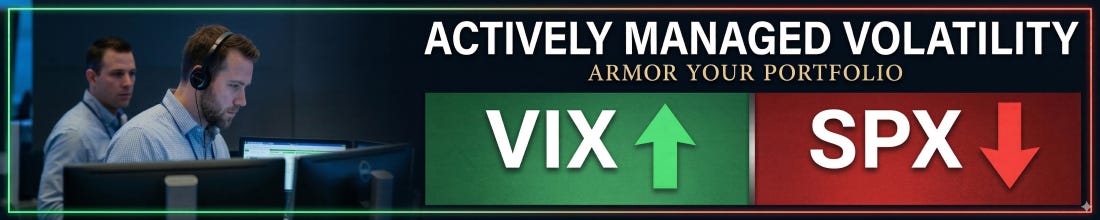
At the core of the Rational Equity Armor Fund is a structure most long-vol strategies never bother to build: an active interplay between Long VIX Futures and a specifically engineered SPX options position.
The VIX futures give you the explosive crisis alpha when systemic shocks hit — the kind of convex payoff that actually moves the needle when the market falls apart. The tailored SPX options are built to augment that exposure while structurally minimizing the decay that kills passive strategies. We’re not holding VIX exposure and watching it erode through contango. We’re actively managing the relationship between the two, targeting a convex return profile that participates in the upside and reacts aggressively to the downside.
But the most important piece — the one I think separates this approach — is how we use volatility as a rebalancing tool.
When VIX spikes, we’re not sitting on our hands. We’re taking profits on the vol surge and rotating those proceeds into equities. We’re selling fear at its peak and buying equities at their most dislocated. When volatility is dormant and complacency is creeping back into the market, we’re methodically re-accumulating our vol position at lower cost.
Buy low, sell high. Applied to the volatility cycle. It sounds simple. Most investors do the exact opposite — panic-selling equities at VIX 30 and overpaying for protection when fear is already priced in.
Why This Moment Matters
Right now, the market is telling you something important if you know how to read it. SKEW is elevated. The VIX term structure is in backwardation. The market is already “pre-hedged” — institutions have bought protection — and that means the cost of passive insurance is at its most prohibitive. You’re not buying cheap protection right now. You’re buying expensive protection that may already reflect the risk.
In this environment, a passive hedge isn’t safety. It’s a trap.
An active approach — one with the pit-tested discipline to harvest volatility profits when others are panicking, and the structural architecture to avoid the bleed — isn’t a luxury anymore. It’s the third pillar that the modern portfolio actually needs.
The Bottom Line
Your clients don’t want to miss the rally. But they also can’t psychologically survive the crash — and if they bail at the bottom, the long-term damage is permanent. The 60/40 needs a third leg: active volatility management that functions as a profit center, not a cost center.
That’s what we built. Not insurance. Convexity.
If you want to talk about how the Equity Armor approach fits into your client book, start at equityarmorinvestments.com or learn more about the fund directly at rationalmf.com.
Stop paying for the bleed. Start trading the movement.
— Joe Tigay, Portfolio Manager, Rational Equity Armor Fund
This content is for informational purposes only and does not constitute investment advice. Past performance is not indicative of future results. Please consult the fund’s prospectus and consider all risks before investing.