Build Here. Invest Here. Win Here.
The Nvidia story deserves an investigation. America’s AI advantage deserves a national commitment.
Thanks for reading Joe's Substack! Subscribe for free to receive new posts and support my work.
Neuter the channels delivering restricted AI chips to China. Build the computing capacity here. Fire up the servers and give America the tools to win.
That is where I want to start, because it is easy to get distracted by everything else in this story.
And there is plenty to get distracted by.
Sex. Suspected espionage. Questions about corruption. One of the most important executives in the world. A president describing how threatening an AI executive with jail made that person suddenly cooperative.
This story is juicy. But to me, it is so much more.
This is about who leads the AI revolution. Who controls the infrastructure. Who sets the rules. Whether the most powerful technology of our lifetime strengthens democratic societies or gives authoritarian governments even more power.
We cannot afford to lose this race.
The moment that got my attention
Watch: Trump discusses threatening an unnamed AI executive with jail — starts around 24:20
The relevant exchange runs approximately 24:20–25:15. Trump does not identify the executive.
For me, the story crystallized when Trump went on 60 Minutes and described threatening an executive at a major AI company with jail—and how dramatically that executive’s behavior changed afterward. He never named the person. Listening to it, my reaction was that the president sounded like he was bragging about having an AI executive in his pocket.
Then look at the reporting surrounding Nvidia.
The New York Times reported that U.S. officials believed a woman involved with Jensen Huang was working for Chinese intelligence. It also reported that Marco Rubio briefed Trump before Huang joined the president’s May 2026 trip to China—and that this was at least the second briefing Trump had received about the relationship.
That raises questions well beyond anyone’s personal conduct.
What did Washington know? What safeguards followed? Who was responsible for protecting the company’s technology and America’s interests?
And why is this information emerging now, immediately after the election?
Is someone getting ahead of a bigger story? Preparing for congressional scrutiny? Establishing their version of events before the next disclosure?
I don’t know what happens next. But the timing deserves attention.
The chip problem was already public
The availability of restricted Nvidia chips in China has sometimes been treated like an industry open secret. More precisely, the warning signs have been publicly documented for years.
In 2024, Reuters reported that Chinese institutions acquired advanced Nvidia chips through resellers in servers made by Dell, Super Micro and Gigabyte. Nvidia disputed that the transactions demonstrated export violations, and the server manufacturers said they complied with applicable rules or would investigate.
In a separate Singapore case, authorities charged individuals with allegedly misleading Dell and Super Micro about the intended users of servers. Those allegations involved fraud against the suppliers.
The incentives are easy to understand.
Nvidia wants to sell chips. Server manufacturers want to sell servers. Customers want computing power. American companies throughout that supply chain benefit from more business.
I manage money for a living. I understand why shareholders like growing sales.
But commercial incentives and national-security interests do not always line up. Government needs to understand where the equipment ultimately goes and who controls it.
Look at Singapore
Singapore’s share of Nvidia’s reported revenue more than doubled between fiscal 2023 and fiscal 2025, reaching $23.7 billion. These figures reflect customer billing locations; Nvidia says actual shipments to Singapore represented less than 2% of fiscal 2025 revenue.
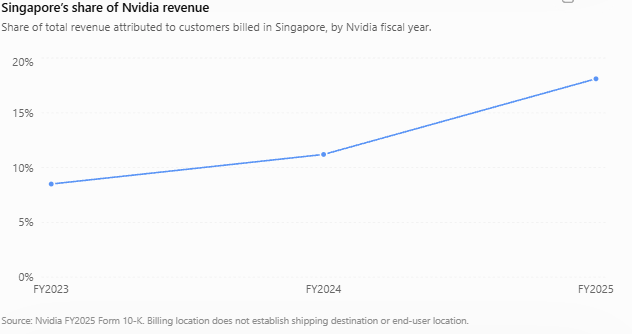
That distinction puts the focus exactly where it belongs: Where did the equipment go after it was billed?
Nvidia subsequently changed its geographic reporting from customer billing location to customer headquarters, beginning in its third quarter of fiscal 2026. That prevents a straightforward continuation of this Singapore series.
The growth shown here predates Rubio’s reported May 2026 briefing. What we need now is a clear accounting of the safeguards and shipments that followed.
The New York Times also reported that a Commerce Department investigation into suspected chip diversion involving Megaspeed was halted following Nvidia’s intervention and transferred to the Justice Department, which requested that Commerce pause its work.
Congress should establish who made those decisions, why they were made and what enforcement followed.
Huang’s apparent 180
When Huang skipped Trump’s inauguration, some investors applauded what they saw as independence. While other technology leaders gathered around the incoming president, the man at the center of the AI revolution appeared focused on running his business.
Nvidia shares rose more than 3% in midday trading that Friday, alongside coverage of retail investors welcoming his apparent distance from politics.
That made what followed surprising.
Huang went from missing the inauguration to accompanying Trump to the Middle East and later China. His public relationship with the president appeared to do a dramatic 180.
To me, he increasingly looked like a political asset for Trump: a prominent business leader whose presence could help validate the administration’s economic and technology agenda.
Now I wonder whether that political usefulness is fading. Is someone distancing themselves from Huang ahead of a larger fallout? Is the post-election disclosure an attempt to get ahead of what comes next?
That is a question for investigation, not a conclusion I can establish from the timing alone.
The financial commitments deserve scrutiny too.
Nvidia announced a $5 billion investment in Intel alongside a technology partnership. Strengthening American semiconductor capabilities makes sense to me. Huang said the administration was not involved in that investment.
The ballroom is harder to understand.
The Washington Post reported that Nvidia committed $25 million to Trump’s White House ballroom project. Nvidia acknowledged contributing and said the donation was independent of its business interests.
Why is a company with so much riding on federal decisions spending shareholder money on the president’s ballroom?
Follow the money. Examine the communications. Establish the timeline.
Investigate it. Then build.
I admire what Huang has built. Nvidia is an extraordinary company and a crucial piece of America’s technological advantage.
That makes accountability more important.
Yes, Democrats need to uncover corruption wherever the evidence leads. Yes, AI needs sensible regulation. We need national-security protections and rules people can trust.
But most importantly, America needs to win.
Democrats have power here. Use the oversight. Use the votes. Use the negotiating leverage. Demand answers, then help deliver the infrastructure this country needs.
I don’t want this to end with hearings, embarrassing clips and another argument about Trump. I want an investigation that produces answers and a national commitment that produces results.
Trump needs to bring Democrats into that effort. Democrats need to help make it happen. The commitment has to survive the next election.
Our advantage will not protect itself
Eric Schmidt recently described China as roughly six months behind in AI, compared with a gap he had previously estimated at one or two years. Demis Hassabis has also described Chinese frontier capabilities as being within months of leading Western laboratories.
As an investor, I hear that and think about risk.
We have extraordinary companies, researchers and capital. We also have infrastructure bottlenecks, political dysfunction and commercial incentives that do not always serve the national interest.
Winning is not guaranteed.
I want Manhattan Project urgency and moonshot ambition. Build the electricity. Expand the grid. Strengthen semiconductor manufacturing. Invest in research. Put more computing power into American projects and the hands of people building our future.
Neuter the channels supplying restricted technology to China. Enforce the rules consistently. Make American leadership something we invest in every day.
I want America and our democratic allies to beat the Chinese Communist Party in this race. I believe the world will be worse off if an authoritarian government sets the terms of the AI era.
We don’t know what happens next with Huang. We don’t know what the next disclosure will bring.
We can decide what we do next.
Build here. Invest here. Win here. Fire up the servers. Let’s go.
If we squander this advantage while everyone protects their own interests, we will have nobody to blame but ourselves.
Thanks for reading Joe's Substack! Subscribe for free to receive new posts and support my work.